Umbrella Beginners: Anatomy of an Umbrella Explained
You have probably owned five umbrellas in your life and never once looked at the underside of one. That is fine. An umbrella works whether or not you can name its pieces. But the moment you go to buy one, or the moment a good one fails on you, the vocabulary starts to matter. A cheap drugstore model and an expensive storm umbrella are not different in some mysterious, brand-driven way. They differ in rib count, rib material, seam construction and how the runner locks in place. Learn those four things and you can judge an umbrella in about thirty seconds, on the pavement, with the tag still attached.
Here is the anatomy, from the top down.
The canopy is the fabric roof, and it is not cut from a single sheet. It is sewn from wedge-shaped panels that meet along seams. Eight panels is the common standard. Budget umbrellas often use six. Better ones use ten or sixteen, which produces a rounder, tighter dome. Fewer panels means fewer seams and fewer places for water to creep through, but the shape gets boxier and the fabric flatters less in wind.
Most canopies are polyester or nylon. You will also see "pongee" on labels, which is a weave rather than a fibre, and it usually signals a fine, tightly woven cloth. What matters more than the name is the finish. A good canopy sheds water in beads. A poor one "wets out", meaning the fabric darkens and water soaks in rather than running off, and then it drips on you from the inside. If you can, check whether the seams are taped or sealed. Flat seams on a coated fabric hold up much better than raw stitched edges.
Size is usually given as an arc measurement in inches, taken across the curve of the dome. As a rough guide, something in the low forties covers one person and a bag. Anything from the mid-fifties upward will shelter two people without a shoulder getting soaked. Depth matters too. A shallow, flat canopy keeps rain off your head but lets sideway rain reach your shoulders.
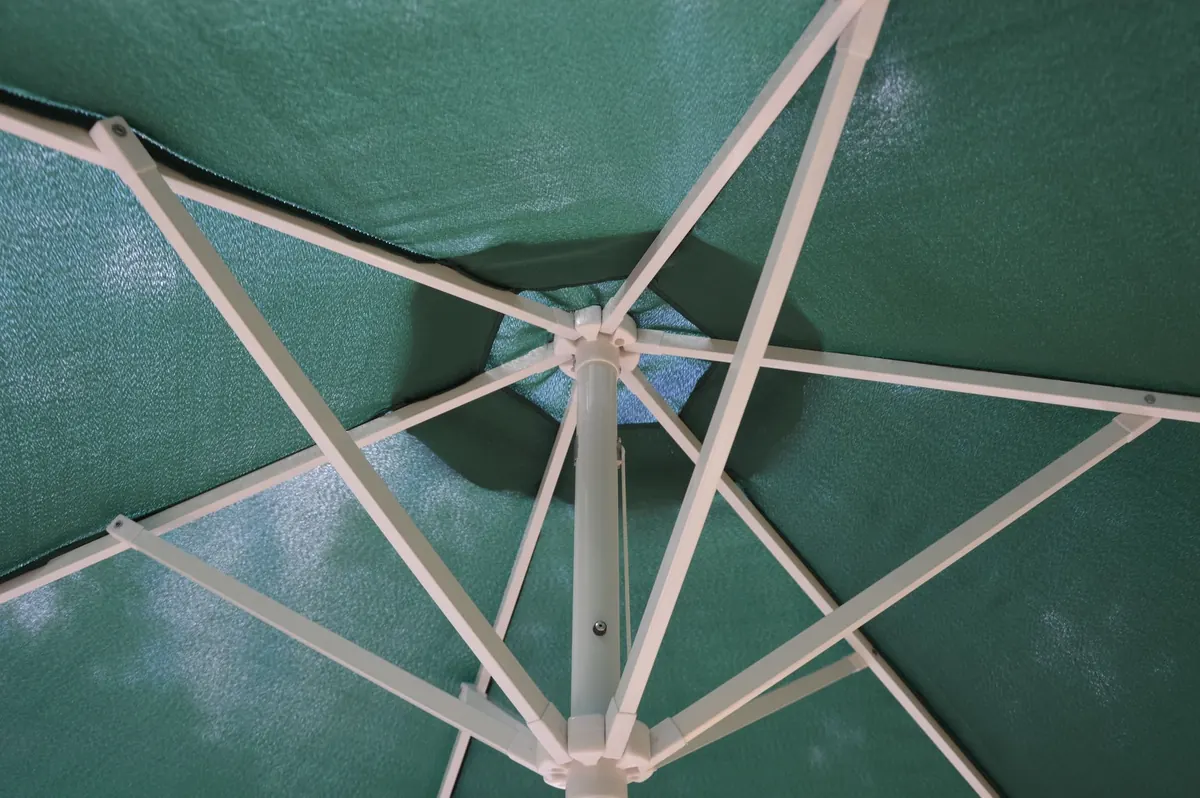
Ribs are the long bones that radiate from the top of the shaft out to the canopy edge. Their number is the single most useful specification on the whole umbrella. Six ribs is budget territory. Eight is normal and perfectly serviceable for city use. Ten to sixteen is where wind resistance begins, because the load is spread across more points.
Rib material tells you how the umbrella will fail. Steel is stiff and strong until it rusts, which it does quickly once the paint is scratched. Aluminium is light and cheap but bends and, annoyingly, stays bent. Fibreglass flexes under a gust and springs back, which is why it dominates mid-range and storm umbrellas. Carbon fibre is lighter and stiffer still, and you pay for it.
Stretchers are the shorter struts running from the runner up to each rib. Together with the shaft they form a triangle, and that triangle is what actually holds the canopy taut rather than flapping. On cheap umbrellas the stretchers are thin wire that kinks the first time the wind inverts the canopy. On better ones they are flat metal or fibreglass, and the strongest designs double them up so each rib gets two.
Signs of a frame worth paying for:
The shaft is the central pole. A one-piece shaft is stronger and gives you more headroom when open, but it stays long when folded. A telescoping shaft in two or three sections collapses small enough for a backpack at the cost of some rigidity.
Materials follow the same logic as ribs. Steel is sturdy but rusts. Aluminium is lighter and dents. Wood looks good and weighs a ton. Fibreglass is a sensible middle ground.
The runner is the collar that slides up and down the shaft. When it reaches the top, a spring-loaded pin or a friction catch holds it there. On an auto-open umbrella, a compressed spring drives the runner upward for you. Two habits will save you an umbrella: never force a stiff runner, work it gently instead, and keep an eye on the runner for cracks. If the runner splits, the umbrella is finished, no matter how good the canopy looks. A metal runner on a metal shaft is a small detail that adds years of life.
Handles are where personal taste gets a vote, but shape does affect use.
Materials run from moulded plastic to foam, rubber, leather and hardwood. Wood and leather age gracefully and look better scuffed. Rubber and foam grip better when wet. A push-button sits in or near the handle, but remember it is only a release for the spring further down the shaft. If gripping an umbrella is painful or difficult, a thicker, softer handle helps, and a shoulder-strap or hands-free design is worth considering. For anything persistent, ask your doctor or an occupational therapist rather than guessing.
The whole assembly does one elegant thing. Here it is as a sequence:
Closing runs the same sequence in reverse, which is why lowering it gently by hand at the runner is kinder than slamming the button and letting the spring do the work.
Turn the umbrella over in the shop and look at the underside. Count the ribs. Flex one gently to see whether it springs back or stays bent. Run the runner up and down the shaft and feel for grit or wobble. Check the seams for tape or sealing, and squeeze the canopy fabric to see whether it feels crisp and coated or limp and thin.
Then match it to how you live. If you walk to work in a city, a light eight-rib telescoping umbrella with a rubberised handle will serve you better than a heavy wooden one you leave at home. If you stand on a platform in exposed weather, spend the money on fibreglass ribs and a vented double canopy. If you keep one in the car for years and forget about it, favour aluminium and rubber over anything that rusts or dries out.
None of this is complicated. It is just a dozen parts, and now you know what each of them does.
Photo: Ulrick Trappschuh / Pexels
Previous Post
Compact vs. Full-Size Umbrellas: Which Is Better for City Commuting?
Next Post
7 Common Umbrella Mistakes That Shorten Its Life